Farrellmedia |
|
 Reports and commentary on the news, science, and creative ends of the media. Contact: My Most Recent Book MEDIA LOG Blogroll: |
Friday, March 05, 2010
Mead drubs the Times for its poor coverage of Climategate: Admit mistakes? Open up their data? Change the way the work? You mean there was something wrong with the way climate science was operating last year? Is the Times telling us that the climate scientists�on the basis of whose work the whole world is debating complex and far-reaching changes in its economic structure and political governance�were using slipshod and careless procedures that need to be fixed? 0 comments Thursday, February 25, 2010
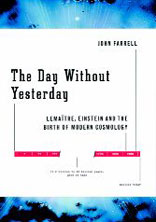
Nice interview of astrophysicist Saul Perlmutter on his work in the 1990s revealing how the universe's expansion rate is accelerating. If he were still alive, Fr. Georges Lemaitre would have been thrilled at this discovery. (Not that he would have stuck his tongue out at Einstein or Fred Hoyle or anything...) 0 comments Wednesday, February 24, 2010
Humphrey Clarke is not impressed with Jason Rosenhouse's recent review of Galileo Goes to Jail. Rosenhouse�s reaction to the book demonstrates the difficulties of refuting the set of comfortable myths that people on both side of the science-religion debate tend to subscribe to. Although you might succeed in denting them, you will commonly find that a smaller, yet no less weaker myth is erected next to them and asserted with just as much force. Our view of late antiquity �through the lens of Edward Gibbon � used to be that of a book-burning free for all with fanatical Christians running around destroying the fruits of the Greco-Roman world and replacing the rational thought of Hellenistic culture with obscure discussions about how three people could fit plausibility into one person and what angels get up to at weekends. This is such an appealing image that it�s a hard one to let go of. Eventually the view Rosenhouse goes for (which is similar to Richard Carrier�s) is that the early Christians did not kill science, they merely lost interest in it (although I don�t know what a figure like John Philoponus or Boethius would have made of that). This is in many ways as powerful a myth as the previous one. A concerted effort by Christians to kill all science for a thousand years is, well, kind of cool. Simply losing interest is just lame.Well said. 0 comments Tuesday, February 02, 2010
I agree with Phil Plait. We should plan on returning to the Moon...and staying there. I don�t want a repeat of the Apollo program: a flag-and-footprints mission where we go there, look around, and then come home for another 40 years. I want to go there and stay there. Apollo was done as a race, and the goal of a race is to win. It wasn�t sustainable. We need to be able to figure out how to get there and be there, and that takes more than just big rockets. We need a good plan, and I�m not really sure what we had up until this point is that plan. Building a heavy-lift rocket that can take us to the Moon, Mars, and near-Earth asteroids is not really easy. It�s not like we can dust off the old Saturn V plans and start up the factories again. All that tech is gone, superseded, and we might as well start from scratch with an eye toward newer tech. This budget is calling for that, as well as relying heavily on private companies. Labels: science, space exploration 0 comments Sunday, January 31, 2010
The Zookeeper God Over at Jerry Coyne's blog a few weeks ago, a generally positive re-posting of Francisco Ayala's critical review of Stephen C. Meyer's book received this familiar comment from Russell Blackford: All good stuff, I guess, but Ayala is mistaken if he thinks that God is off the hook for the predictable evils of the evolutionary process merely because he doesn�t micromanage it. God supposedly set up that process, on Ayala�s account, but even a less-than-omnipotent being could foresee the kinds of evils that would inevitably arise. Why not just create a world without those evils in a blink of time, which is well within the capacities of an omnipotent being?Yes, why not? Well, the first problem with a world like the one Blackford asks for is that it would hardly be one in which anything remotely like science as we understand it could exist. How in such a zoo--for that is obviously the kind of world he's talking about, where the bloody process of natural selection doesn't happen and all critters are protected from harm--could investigation of natural causes come about? The first thing animals in a zoo come to terms with is the boundary, the physical constraint. Then feeding time. And of course help when inadvertent injury occurs. Identity of the Zookeeper (and assumed identity of the zoo designer) is trivial in this case. Can you imagine curiousity in such a world for the occupants of the zoo, however smart they might be? After all, we would assume they were "created" (in Blackford's simplistic sense of crafted) as humans like us in the blink of an eye. With the same intelligence one presumes. But can we assume in a world that did not (like the real one) unfold according to consistent physical laws that anyone would ever develop, say, a system of mechanics that can describe motion mathematically? If you've never been beaned by an apple falling from a tree. Or you've never seen the roof of a cave collapse on a hapless group of children or pups. Or a meteorite strike the earth. After all, you live in a zoo world where the Zookeeper doesn't allow that. Even assuming you had some community of individuals in the zoo that were interested in the nature of gravity, why would they bother investigating it when they can just ask the Zookeeper? The response usual as this point is that, well, okay, maybe it's not a zoo where nothing bad happens, but perhaps a world where the more egregious examples of natural evil--earthquakes etc--could have been been done without, thank you very much. This doesn't follow either. You can't slightly modify the laws that cause plate tectonics, shifts in the earth's mantle, etc without also modifying the laws of physics right down to the bottom. You can't have a "sort of" real world but with protections built in. It's like intelligent design proponents arguing with a straight face that they accept common descent but that evolution couldn't happen without design. It's not coherent. Oh. Wait a minute--that's exactly what they do argue. Sorry, wrong analogy. Seriously it's not the wrong analogy. If atheists mean to defend and cherish science, as they should, then impatient retorts like, "why couldn't there have been less suffering in the natural world?" boils down to the same refusal of IDers to accept evolution that atheists love to ridicule. Furthermore, not having come into being by natural selection etc, is it even reasonable to assume humans in this zoo would have the slightest interest in freedom? Is not our desire for freedom to be explained as much by our evolved nature as our skin color? Our eye color? Remember, there are no asteroid collisions in this Zoo. No black holes ripping galaxies apart and no supernovae blasting dust clouds to coalesce into new planetary systems. No traces of this kind of turning out to arouse our awe and curiousity. Everything. Just. Is. Science in such a world? I doubt it. The laws we have in this world cannot be arbitrarily constrained and still offer the source material for the study that undergirds the knowledge the human race has painfully accumulated over the past 2500 years. This hearkening after a never-never land--apparently the only one in which arguments for a benevolent God wouldn't be scorned by philosophers like Blackford-- seems to be quite prevalent among otherwise clear thinking skeptics. Many sciencebloggers repeatedly express their moral disgust with the bloody process of evolution and yet never pause to reflect for a moment whether any meaningful hard fought science could even be possible in the zoo where the Zookeeper never allows that stubbed toe or disastrous flood to happen. This of course leads to the age-old philosophical question, do we really learn anything lasting without suffering? Yet Blackford seems to think the only argument for God he could accept would require the creation of a world in which we can. Strange. 3 comments Thursday, December 17, 2009
Extra solar watery world: The planet, named GJ 1214b, is 2.7 times as large as Earth and orbits a star much smaller and less luminous than our sun. That's significant, Charbonneau said, because for many years, astronomers assumed that planets only would be found orbiting stars that are similar in size to the sun. 0 comments Wednesday, August 26, 2009
New steps toward quantum gravity: Despite the success of general relativity, one of the most important problems in modern physics is finding a theory of quantum gravity that reconciles the continuous nature of gravitational fields with the inherent 'graininess' of quantum mechanics. Recently, Petr Ho?ava at Lawrence Berkeley Lab proposed such a model for quantum gravity that has received widespread interest, in no small part because it is one of the few models that could be experimentally tested. In Ho?ava's model, Lorentz symmetry, which says that physics is the same regardless of the reference frame, is violated at small distance scales, but remerges over longer distance scales Labels: relativity, science 0 comments Friday, June 26, 2009
Science and Religion Brandon Watson does a nice job picking apart the faulty logic behind Sean Carroll's recent post on the alleged incompatibility of religion and science. (That said, Sean's a lot more thoughtful than Jerry Coyne.) 0 comments Copyright 2010 by Farrellmedia, Inc. All Rights Reserved. |