Farrellmedia |
|
 Reports and commentary on the news, science, and creative ends of the media. Contact: My Most Recent Book MEDIA LOG Blogroll: |
Monday, April 20, 2009
The Drowned Giant British writer J.G. Ballard has passed away at age 78. Mostly known for his novels Crash and Empire of the Sun, both made into mediocre Hollywood films, he was to my mind a better short story writer. His collection The Terminal Beach includes two of my favorite short stories, The Drowned Giant and The Lost Leonardo. The former was about the reaction of a seaport city to the appearance of a dead giant, washed up on the beach one morning. Labels: J. G. Ballard, literature, science fiction 1 comments Tuesday, March 24, 2009
Updike, Science Fiction and "the Modernist position" In the back-page editorial for the latest (March) issue of the New York Review of Science Fiction, David G. Hartwell passes along some grim forecasts for the field in publishing (which I'll discuss in a separate post). After which he writes: I had hoped to devote this editorial entirely to John Updike, but a condensed version will have to do. Updike was one of the principal arbiters of literary taste in the U.S., a writer of extraordinary talent, and, like Edmund Wilson, a fine book reviewer, principally for the New Yorker. Like W.H. Auden in the generation before him, he was interested in science as well as literature, and Updike was the single most influential force in establishing the literary acceptability of Ursula K. LeGuin in the mainstream in the U.S. He uttered an authoritative marginalization of science fiction as a whole in his New Yorker review of my own A World Treasury of Science Fiction--in part authoritative because it came from a selective sympathizer. He set up his discussion with what he called the crucial question: "What keeps science fiction a minor genre, for all the brilliance of its authors and apparent pertinence of its concerns?" His answer I always found unsatisfactory: "Each science fiction story is so busy inventing its environment that little energy is invested in the human subtleties." My short version response is that this is fairly clearly a restatement of the Modernist position that good literature is solely about the inner life of characters in ordinary situations. Science fiction in general does not attempt that but excels at the behavior of characters in unusual and at best entirely plausible invented settings. I invite our readers to comment. Now...there are a couple of things one can say about this. I would agree with DGH, first of all, if you accept his version of the Modernist position. But... I'm not sure that's a fair version. One can, for instance, find modern novels that are about the inner life of characters in not-so-very-ordinary situations and not-so-ordinary settings--even if the environments are more familiar than those posed in SF novels. (I'm talking about hard SF, not Fantasy.) For example, off the top of my head: Lord of the Flies. Sophie's Choice. Anything by Elmore Leonard. Atonement by Ian McEwan. If many mainstream novels are quite obviously about ordinary people in extraordinary circumstances (the Holocaust, World at War, etc.), you can argue this undercuts SF's claim to special consideration. If all you have to distinguish the genre now is the invented environment (however plausible)--I don't think it's enough. And it seems to me that Updike's criticism --SF is long on environment, short on humanity--can still be made of many SF novels. [Obviously not all--and there are superb writers like James Morrow, Jonathan Lethem, Mike Flynn, Ken MacLeod, Neal Stephenson, Bruce Sterling, among my favorites) who write so well they transcend the genre.] Unfortunately, I think critics can still claim SF novels often sacrifice character and plot for the sake of their environments. A lot of SF novels you see on the shelves--if you can easily pick them out from the surrounding interminable series of infantile vampire novels, just don't invite a second reading. So, inventing a different environment can't get SF off the hook, I think, for not producing more of what most in the mainstream of readers expect in a good story, including--especially--the human subtleties. I know a lot of SF writers and editors were unhappy when the late Stanislaw Lem unloaded on the genre in his now infamous essay from the early 1970s--but his point I think still stands: Too many hard SF stories are just not very well written--with characters that are shallow and uninteresting. Dialogue is very often mediocre at best (I just finished one, for example, about a hop-scotch trip across the galaxy through wormholes that frankly could have succeeded much better without any dialogue at all.) Last week I linked to Will Saletan's coverage of the young Japanese woman who underwent IVF and then aborted the child when she found out the doctor had made a mistake and implanted an older woman's embryo--in essence the latter's last chance to have children at all. The story is, as Saletan observes, both grotesque and agonizing. Clearly the technology and science have made for new circumstances which few people might have foreseen. The result: tragedy. Now, if Ursula K. LeGuin had written this as a novel 40 years ago before IVF was even available, during the New Wave of SF, with all of the tragedy, pathos and poignancy it brings to the surface here as a news story, Updike might well have labeled it a triumph. It would be available in a nice edition from Farrar Straus & Giroux and not as a cheap paperback with a second-rate cover. (How SF is branded and marketed by the publishers is a whole separate topic--and in my opinion has to loom large as one of the reasons it still isn't taken seriously.) But in fact, no one in SF did write this story 40 years ago. Or, if they did, it was so poorly written it never rose to the surface after it appeared in Galaxy or Amazing Stories. So I think Updike's point is still well taken. Unfortunately. Labels: literature, science fiction, writing 6 comments Tuesday, June 10, 2008
Phil Plait gives an excellent summary of some seriously spooky quantum experiments on the international space station. Labels: quantum mechanics, science fiction 0 comments Friday, May 23, 2008
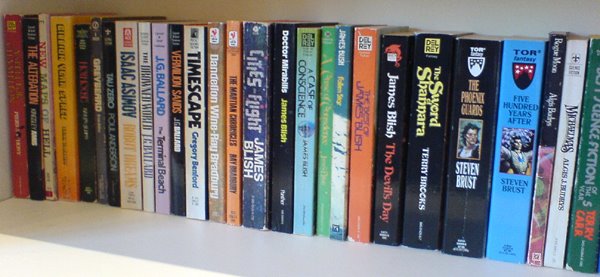 One of the joys of moving into a new (larger) house is (at last) finding the shelf space for your classic science fiction paperbacks! Labels: books, science fiction 2 comments Tuesday, May 13, 2008
I'd like to start my review of Cory Doctorow's Little Brother with a disclosure. I haven't read Young Adult novels before (nada, zippo, not one), but I can't say it made the slightest difference: I wasn't stopping here and there to remind myself, 'okay, cut the author some slack, he's writing for teenagers for God's sake, so he can get away with this, or that gimmick.' I just read it like any other novel, and found it a lot more interesting and thought-provoking than many of the adult level audience novels I more regularly read...(Speaking of which, what would happen if you crossed Cory Doctorow with Ian McEwan...?) [shudder] The plot summary I'm going to crib from Chad Orzel: Pretty much, that's it: but a lot of the fun and suspense of the book is exactly how Marcus goes about his work. And that kept me turning the pages. Second disclosure: I'm not exactly in sympathy with all of the positions the author espouses; and it was an exercise in self-examination, as I read this romp about young revolutionary techno-geeks using every trick in the book to fight the agents of Homeland Security, to picture ...well, where I would fit in the plot if I was the same age. It was none too edifying to realize I'd probably fall into one of three scenarios: the little bookworm who
Doctorow's style: Chad mentions, for example, "...that there is not a subtle sentence in the entire book-- the Important Message is hammered home as hard as any message has ever been hammered home." I don't agree. Going back over some highlighted gems from my pages, I find little samples like this: I don't fold. I have a trick for staring down people like Benson. I look slightly to the left of their heads, and think about the lyrics to old Irish folk songs, the kind with three hundred verses. It makes me look perfectly composed and unworried. (p. 13)I think every kid figures something like this out, and it clicked with me as soon as I read it. (Only difference, I would look to the right side of their heads, and start thinking about Richard II, Act 5, Scene 5, "I have been studying how I may compare this prison where I live unto the world...") I like Marcus's voice. Yes, he's a smartass--but not a complete smartass. Doctorow manages to educate the reader on various aspects of encryption and programming without ever stepping outside of the kid's natural tone. I don't consider myself a programmer, but I've had do enough tinkering in the various multimedia programs and my own web sites, to appreciate why programmers love to code. Making computers do what you want is cool. Some readers have complained about the 'deus ex machina' ending to the book (which I will not divulge), but again, I think this is not fair to the author, who sets up all of his plot twists with plenty of foreshadowing, so I read right to the end without a hiccup. I found only one false note (or rather, one note that didn't ring true at all for me). And that was the pitch to revive the 'generation gap.' At the first secret party to organize themselves, Ange stands out among the newbies and goes full throttle into a rant about the suspiciousness of anyone over age 25: "They forget what it's like to be our age. To be the object of suspicion all the time! How many times have you gotten on the bus and had every person on it give you a look like you'd been gargling turds and skinning puppies?" (p. 166) Okay, maybe Boston is different from San Francisco. Most of the time I see kids get on the T or buses with me, they're not getting any looks at all. They get loud enough you'll see every man and woman over 30 just keeping their head down and staring at the floor--too intimidated to say a word and just hoping they get off at the next stop. Like I said, a minor caveat. And I'm well over 25 anyway, so don't trust me. Labels: book review, science fiction 0 comments Copyright 2010 by Farrellmedia, Inc. All Rights Reserved. |